“Creative Industry in Practice” Connects Academia, Art and the Creative Sector
For this edition of Global UBT Fest 2026, the Faculty of Art and Digital Media presented the summer school “Creative Industry in Practice” at the Ulpiana Art Centre in Prishtina. The programme brought together artists, musicians, curators, cultural professionals, independent organisations, alumni and academic staff, creating a direct connection between higher education and the realities of the creative sector.
The Faculty of Art and Digital Media has continuously developed projects beyond the conventional university environment, working with communities, cultural organisations and public spaces. Hosting the programme at the Ulpiana Art Centre reflected this approach, transforming the event into a platform where students could encounter professional practice, artistic experimentation and institutional experience within an active cultural setting.
The opening programme featured an experimental music session led by academic staff member Tomor Kuçi, together with Arbër Salihu, known as La Fazani. The session, titled “Deconstruction of Music Production and Songwriting of an Original Song,” offered participants insight into the development of an original musical work, from the initial idea and songwriting process to arrangement, production and final interpretation.
Through the dialogue between academic guidance and professional artistic practice, the session explored how a musical identity is developed over time. La Fazani’s artistic journey demonstrated how a sustainable career is built through commitment, experimentation and a consistent relationship with creative practice. Tomor Kuçi contextualised the production process and connected the artist’s professional experience with the learning objectives of the programme.
The second day brought together contributors whose practices connect artistic production with cultural institutions, public policy, independent organisations and festivals.
Skender Boshtrakaj presented the session “Cultural Policies, Public Institutions, the Development of the Creative Sector, and Copyright Protection in the Creative Industry.” Drawing on his experience in both artistic and institutional contexts, he discussed the responsibility of public institutions in supporting artists and cultural organisations.
His contribution examined the need for stronger and more sustainable cooperation between institutions, communities, education and the creative industries. Particular attention was given to copyright protection, professional structures and public policies that recognise the economic, cultural and social value of artistic practice.
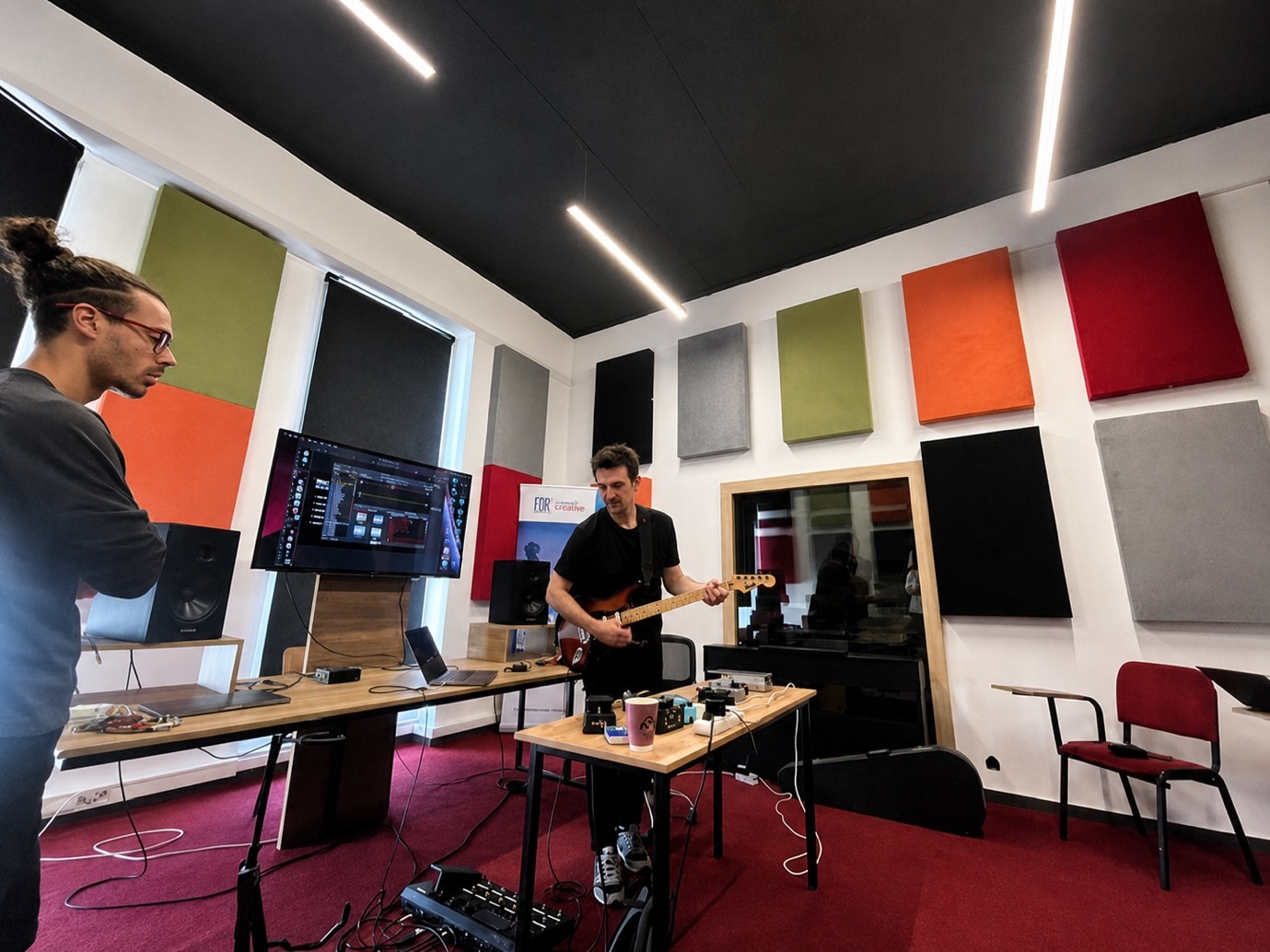
The programme continued with Visar Kuçi, who led the session “Guitar Pedals for Live Performances and Studio Applications.” Combining technological and analogue approaches, the workshop explored how sound can be transformed, layered and manipulated in live performances and studio environments.
Participants were introduced to the creative potential of technical equipment and encouraged to understand technology not only as a supporting tool, but also as an active element within artistic production. The workshop created a direct connection between experimentation, sound technology and contemporary musical practice.
Leon Emra, representing ARKIVI, presented the session “Independent Art Institutions, Alternative Spaces and Contemporary Practice.” ARKIVI, initiated by internationally recognised artist Sislej Xhafa, was introduced as a cultural organisation concerned with artistic research, curatorial development and contemporary practice.
The presentation addressed the role of independent organisations in creating alternative structures for artists, curators and researchers, particularly in contexts where institutional opportunities remain limited. It also introduced participants to ARKIVI’s vision, curatorial programme and approach to developing new forms of artistic collaboration and cultural production.
The programme also highlighted the professional development of UBT alumni, with Vita Kasapolli participating as a graduate of the BA Art and Digital Media programme. She has since developed her career as a project manager and curator at Anibar in Peja, one of Kosovo’s most recognised cultural festivals with a strong international presence.
Her session, “Animation as an Artistic Practice and the Role of Festivals in the Development of the Creative Industry,” examined animation as both a creative discipline and a growing professional sector. She discussed the role of festivals in supporting emerging artists, developing audiences, encouraging international collaboration and creating professional opportunities within the creative industries.
Kasapolli’s journey demonstrated how academic education can develop into an active professional career within the cultural sector. Her participation also reflected the importance of maintaining relationships with alumni and bringing their professional experience back into the academic environment.
The sessions were supported and contextualised by academic staff and programme coordinators Tomor Kuçi, Burim Berisha and Gazmend Ejupi, who contributed to the development of the programme and to the discussions connecting academic education with professional artistic and cultural practice.
Through presentations, workshops and public discussions, Global UBT Fest 2026: Creative Industry in Practicedemonstrated that creative education becomes more meaningful when students are placed in direct contact with artists, institutions, independent organisations, alumni and cultural professionals.
The programme offered students practical insight into music production, cultural policy, copyright protection, sound technology, independent cultural organisations, animation and festival production. It also presented different professional pathways available to graduates of art and digital media programmes.
By hosting the programme at the Ulpiana Art Centre, the Faculty of Art and Digital Media reaffirmed its commitment to community engagement, public space and collaboration with the creative sector. This edition of Global UBT Fest created a platform where academic knowledge, artistic practice and professional experience could meet, while strengthening the relationship between the university, its alumni, the cultural community and the wider creative industries.